↓ Green dots are behind us, the orange dot is now, grey dots lie ahead.
Solar longitude 45° → 120° | the sun climbs all the way to its northern peak, then turns back on the solstice itself
Where we've come from. Summer didn't rise out of nowhere. We came through late spring —
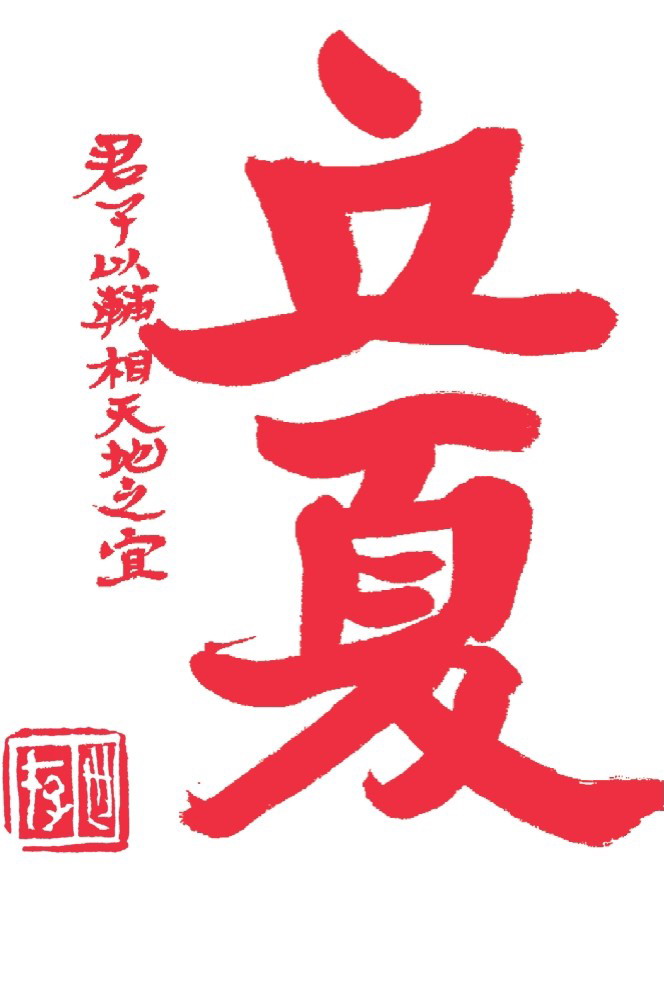
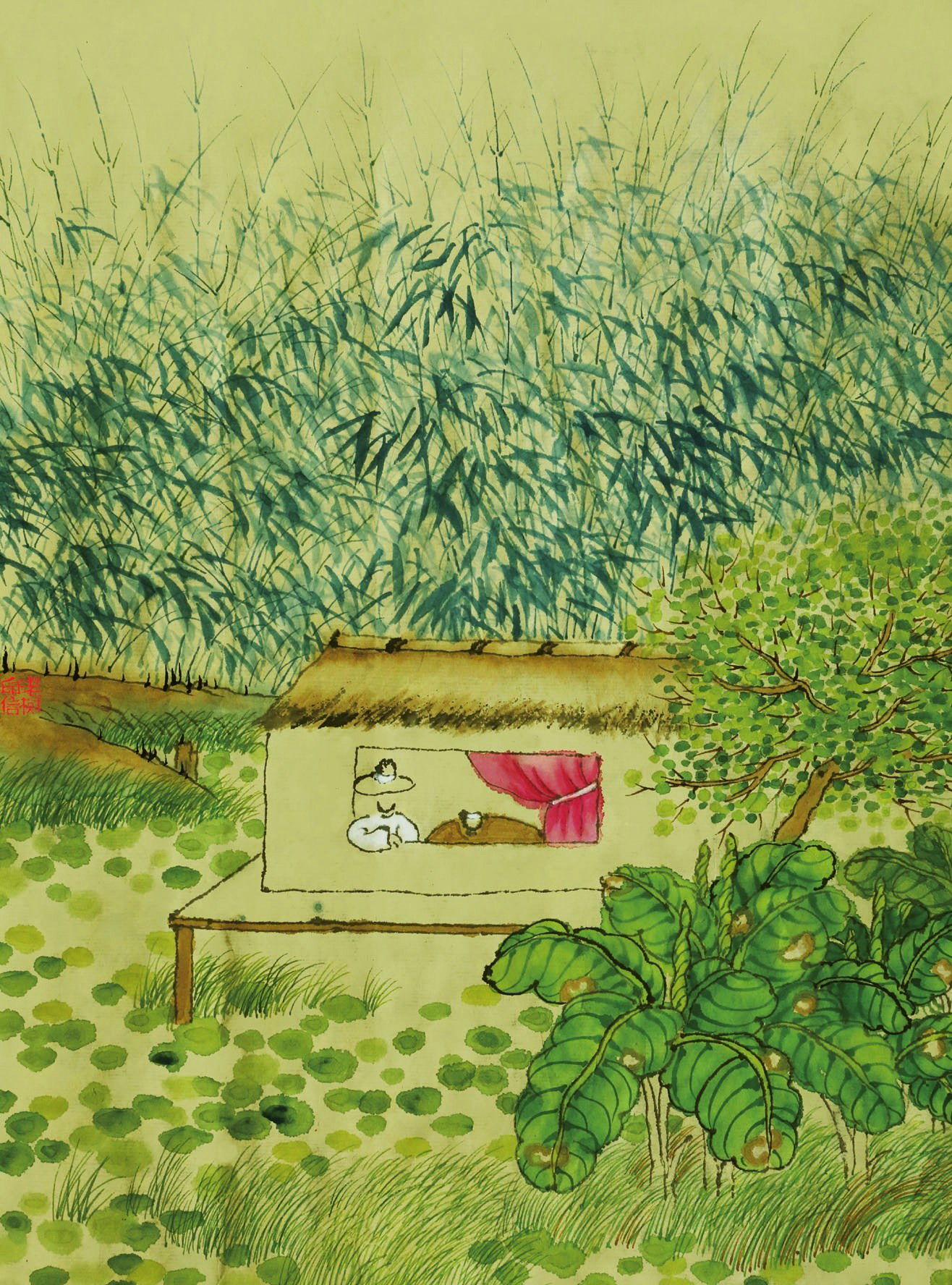
清明 Qingming, 谷雨 Grain Rain — the season of 生, of being born,
of rain settling and everything stirring awake. 立夏 was the doorway:
「斗指东南,维为立夏,万物至此皆长大」 — the Dipper points southeast; this is Summer's onset;
all things have now grown large. Past the door, the season's keyword quietly turns over from
生 (being born) to 長 (growing up). Yu Shicun keeps returning to that single-character difference:
spring teaches you to be a 学生 — a student, one learning how to survive; summer teaches you to be a
学长 — literally a "grown student," an elder, who in growing up takes on order, responsibility, the giving of oneself.
Summer is the season in which all things unfurl — and must answer for the unfurling.
mole-crickets sing · earthworms emerge · the royal gourd's vine climbs
「立,建始也;夏,假也,物至此时皆假大也。」
"To 立 is to begin; 夏, summer, is 假 — a borrowing, a swelling; by now all things have swelled large."
The root of the word 夏 is 假 — a swelling that is not quite real, the way heat expands a thing.
All things bloat outward in the warmth, and so 夏 grows a second meaning: 大, greatness —
「夏,大也,故大国曰夏」, summer is greatness, so a great state is called 夏.
Step by step the word borrows and gains weight until it becomes the name of a people:
「中国有礼仪之大,故称夏;有服章之美,谓之华」 — China has the grandeur of rites, so it is called 夏;
the beauty of robes, so it is called 华. 华夏 (Huaxia), the oldest name for the Chinese, was unfurled out of this summer largeness.
Older still, 夏 meant a direction — "facing south": south was life, yang, the front; due south was the Chinese compass-point, and a "夏 person" meant a southerner.
This is the day of 三阳开泰, "three yang lines opening into Peace." In the Zhou, the king led his court
out to the suburbs to 迎夏, welcome the summer — robes, jade, even chariots and horses all in vermilion,
a body dressed entirely in red to greet the swelling season. Storing ice against the heat is two thousand years old; the Book of Songs
records the chopping of it — 「二之日凿冰冲冲,三之日纳于凌阴」. When summer came the ice was opened and bestowed,
and Yang Wanli caught the small market joy of it: 「卖冰一声隔水来,行人未吃心眼开」 —
the ice-seller's cry carries across the water; before he's even tasted it, the traveler's heart lifts.
The folk 立夏 is lighter. There is the custom of 称重, weighing people: a great steelyard hung at the village gate,
a bench on the hook, everyone taking a turn while the weigher chants good fortune — for a girl, "105 jin, and a wealthy family comes knocking";
for a child, "long will he grow, and high will he rise." There is also the wistful 饯春, seeing spring off with wine and food
as though parting from a traveler — Wu Oufu's line fits it best: 「无可奈何春去也,且将樱笋饯春归」,
nothing to be done, spring is leaving; so with cherries and bamboo-shoots we feast it on its way.
In the body, summer answers to the heart, 心. The Yellow Emperor's Classic: "the three months of summer are called 蕃秀,
flourishing and blooming; heaven and earth exchange their breath, and all things flower and fruit." Heat stirs the heart-fire; people grow restless and quick to anger.
So the keynote of 立夏 health is almost a murmured reassurance — keep the heart open, easy, glad; above all, do not let great joy injure the heart.
And in the great sequence of hexagrams, 立夏 sits where 天泽履 (Treading) gives way to 地天泰 (Peace).
履 is a shoe, is walking surefoot through mud — the dance of the hand is 舞, the dance of the foot is 蹈, and 履 is to stand firmly in the world,
meaning both practice and the ritual order that grows out of practice: 「君子以辩上下,定民志」, the noble one distinguishes high and low, and settles the people's hearts.
泰, Peace, is heaven and earth in exchange: 「后以财成天地之道,辅相天地之宜,以左右民」.
The work of 立夏 is exactly this line: do not master, do not overstep — only assist what heaven and earth already incline toward, and help all things grow at their own pace.
In the end "three yang" (三阳) became "three rams" (三羊), and the meaning came down to earth: the people's livelihood must be truly secured —
even Qianlong's poem knew it: 「展转苦热烦,心在黔黎旁」, tossing in the cruel heat, my heart is with the common folk.
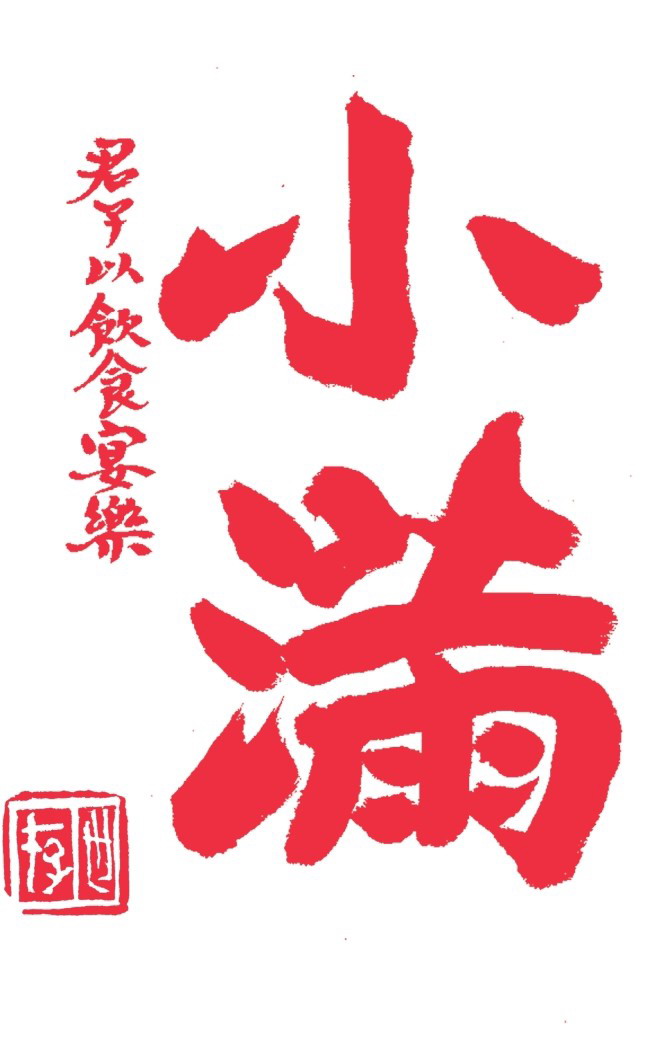
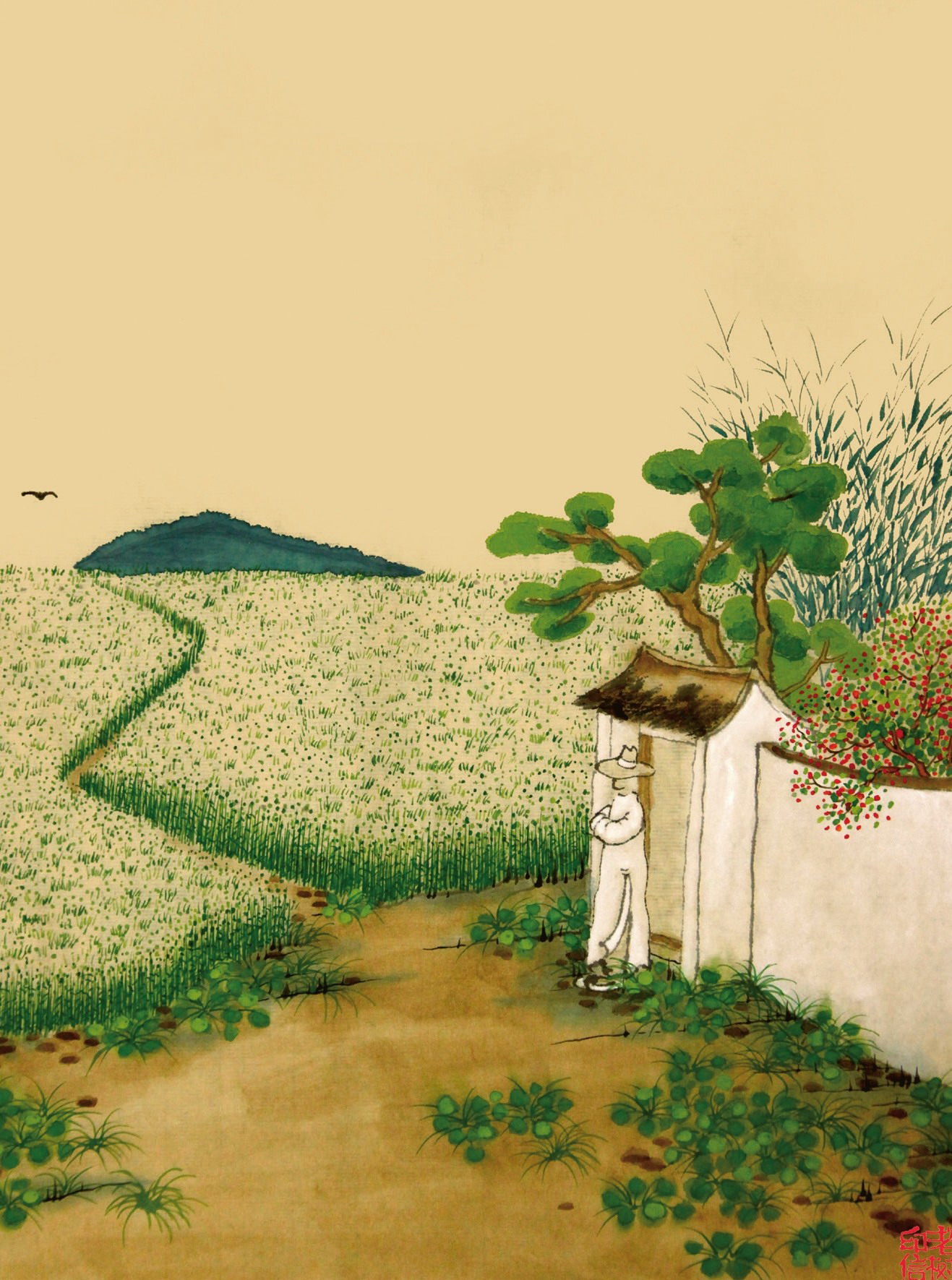
小满xiǎo mǎnGrain Buds · waiting, almost fullwe are here
calligraphy · 小满painting by 老树 Laoshu · 小满
May 20–22 · longitude 60° · hexagram 需 Waiting
three pentads苦菜秀 · 靡草死 · 麦秋至
the bitter herb flowers · the soft grasses wither · the "wheat autumn" arrives
「物至于此小得盈满。」
"By now things have gained a small fullness." — full, but only a small fullness.
In the north the wheat kernels have begun to fill but are not yet ripe — the milky stage; in the south the same word "full" is handed to the rain:
「小满不满,干断田坎」, if the small-fullness doesn't fill, the field-ridges crack dry.
If the paddies can't hold water now, there'll be no transplanting come 芒种. This is when the real labour begins —
「小满动三车」, Grain Buds sets three wheels turning: the water-wheel treading, the oil-press pounding, the silk-reel spinning;
the silkworms reach their cocoons, and the work runs day and night.
What makes 小满 so steadying is exactly that it is not perfect fullness: it is the moment of "almost ready," the process itself.
Its hexagram is 水天需, Water-over-Heaven, Waiting. The ancients wrote the image — water above, heaven below — as a figure
standing at the field's edge, face lifted to the sky, praying for rain. 需 is both to wait and to need.
That suspended interval — cloud risen, rain not yet fallen — is the time-space of Waiting: 「云上于天,需。君子以饮食宴乐」.
In nature it is gazing up for rain; in a life it is youth waiting to be fed, waiting to grow — when the time is unripe, you don't rush;
you only nourish the body with food and bind people with feasting, storing heart and strength. Right now, we live in exactly this seam of almost-but-not-yet.
The native taste of summer is 苦, bitter. "It is fire's breath that makes the bitter taste" — summer's gourds and greens run bitter,
and people named them so outright: 苦瓜 bitter-melon, 苦菜 bitter-herb. The first pentad is "the bitter herb flowers," the earliest food to relieve the lean season:
「苦苦菜,带苦尝,虽逆口,胜空肠」, bitter, bitter herb, taste it with its bitterness — it offends the mouth, but it beats an empty gut.
Yu lays taste out as a coordinate of time and space: spring sour, summer bitter, autumn pungent, winter salt; bitter is also "the taste of the south," "the taste of youth."
He touches the rawest nerve with Lu Xun: 「抉心自食,欲知本味。创痛酷烈,本味何能知?」 —
to dig out your own heart and eat it, hoping to know its true taste; but the wound is so fierce, how could the taste be known?
Pain or loneliness, bitterness can't be told — yet it is the present the living must taste here, now.
The third pentad, "the wheat autumn arrives," should make a bite of new wheat a blessing of new life; yet history's most famous "first taste of new wheat" is a black comedy.
In 581 BCE Duke Jing of Jin dreamed a ghost cursing him; the shaman read it: he wouldn't live to eat the new wheat, 「不食新矣」.
The physician Yi Huan found the illness lodged between the diaphragm and the heart — the origin of 「病入膏肓」, beyond all cure.
On the appointed day the Duke had the new wheat harvested and cooked, summoned the shaman to witness that he could eat it after all — and killed him first.
Then, just as he raised the food, his belly cramped; he went to the privy and 「陷而卒」, fell in and died.
A ruler who held lives as cheap as straw never got that one mouthful.
In 小满, food is never only food: it is the reward of waiting, the cashing-in of timing — and the comeuppance of arrogance.
Where we're going. Once the wheat ripens fully, summer draws its most breathless breath — 芒种 Grain in Ear,
harvesting and planting at once, where order trumps everything. Further on is 夏至, the Solstice: yang at its peak, the longest day —
then 「一阴生」, "one yin is born," and the sun turns south. Last come the furnaces of 小暑 and 大暑,
steamed below and boiled above — the Cauldron and the Well — where the subject shifts from a single body to what everyone holds in common. The road ahead:
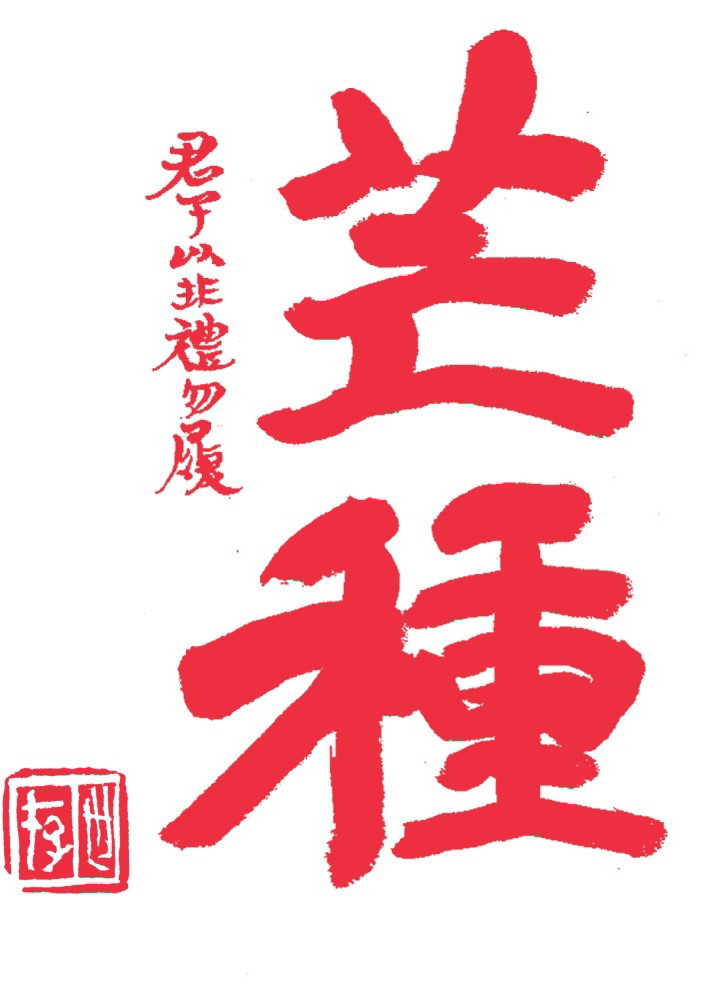
芒种máng zhòngGrain in Ear · harvest and sowingahead · ~11 days
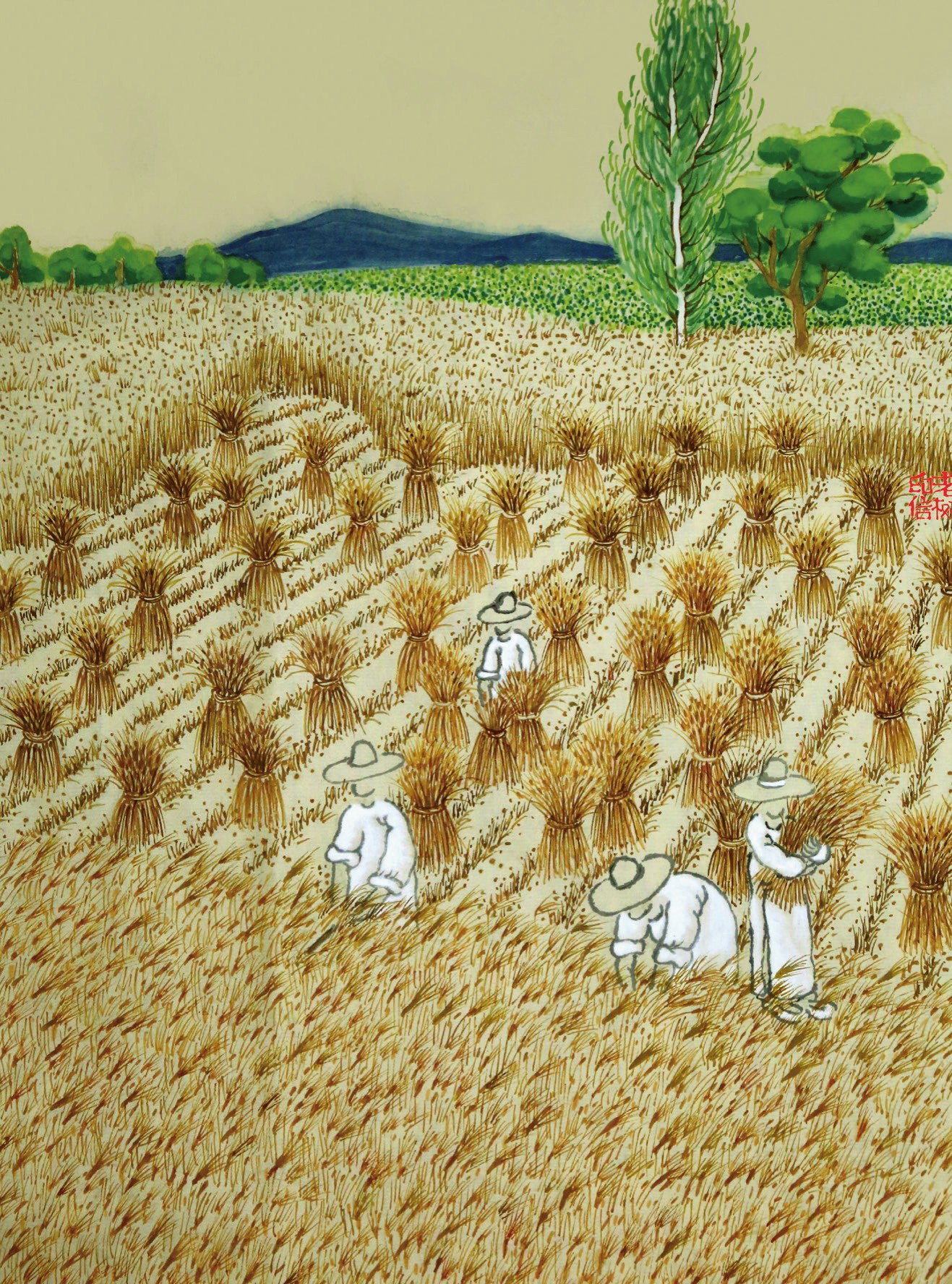
calligraphy · 芒种painting by 老树 Laoshu · 芒种
Jun 5–7 · longitude 75° · hexagrams 大壮 Great Power · 大有 Great Possession
three pentads螳螂生 · 鵙始鸣 · 反舌无声
the mantis is born · the shrike begins to call · the mockingbird falls silent
「有芒之种谷可稼种矣」
"The bearded grains may now be reaped and sown" — bearded wheat to cut quickly, bearded rice to plant.
「春争日,夏争时」 — spring races the days, summer races the hours. 芒种 is summer's least forgiving breath, the three labours of summer at once:
reaping, sowing, tending. The wheat's beard is fine and long, and the harvest is fought like a fire — 「收麦如救火,龙口把粮夺」,
reaping wheat is like fighting fire — you snatch the grain from the dragon's mouth. The plum rains press in; Fan Chengda's lines brim with the wet misery of the Jiangnan farmer:
「梅霖倾泻九河翻……年年披絮播秧寒」. 芒种 is also written 忙种, "busy planting," and the work-song runs breathless, one line shoving the next.
Out of this frenzy grows a singular figure — the 麦客, the wheat-guest: the migrant who reaps another man's field.
Because the wheat ripens at different times in different places, they move like birds from south to north, reaping as they go, so that by the time the late-ripening regions
are cut, their own wheat back home is ready too. They are the rare strangers colliding inside a society of acquaintances — full of friction, grievance, sudden affection,
and parting. After mechanization, the combine-harvesters criss-crossing north and south are called 「铁麦客」, "iron wheat-guests" —
the toil is the same across the ages; only the chafe of the beard is traded for the roar of the machine.
The three pentads hold the ancient eye that read the weather as it read the court. 反舌无声, "the mockingbird falls silent": the bird that mimics
all others goes quiet, sensing the new yin; and the ancients said that if it kept on singing now, "there is surely a sly flatterer beside the ruler."
Following these three creatures, Yu unrolls a whole cultural history — the 螳螂 mantis, in ancient Greece the "praying" insect with arms raised like a worshipper,
in China the fearless warrior of 螳臂当车 (the mantis halting a cart) and 螳螂捕蝉 (the mantis stalking the cicada), out of whose stance Wang Lang forged a whole martial art, 螳螂拳, Mantis Boxing;
the 伯劳 shrike, which carries the grief of Yin Jifu, who killed his own son by slander and then took a bird singing in a mulberry to be the boy reborn — and carries too the phrase
「劳燕分飞」, shrike east and swallow west, a resident bird and a migrant whose natures part them: the very emblem of those who never meet again;
and the 反舌 mockingbird, which runs all the way to Harper Lee's To Kill a Mockingbird — and to the long mistranslation of that title into Chinese as "a robin."
The hexagrams are 大壮 Great Power and 大有 Great Possession: all things at full strength, "upright and great, and the heart of heaven and earth made visible."
Yet precisely because everything is growing at once, branches crowding into branches, the farm-work frantic, order and ritual matter most just here — 「君子以非礼勿履」,
the noble one does not tread where it is not proper. 礼, ritual, belongs in time to summer itself: the visible order growing up between all things.
Yu argues that it is exactly because all kinds vie freely that you need "degree within closeness, pattern within degree" — only so do "see no impropriety, hear none, speak none, do none"
take on a positive, generative force. Here he reaches Confucius's sigh for the Great Unity: 「大道之行也,天下为公……货恶其弃于地也,不必藏于己;力恶其不出于身也,不必为己。是谓大同」 —
when the great Way prevails, the world is shared by all… goods need not be hoarded, strength need not be spent for oneself. This is called the Great Unity.
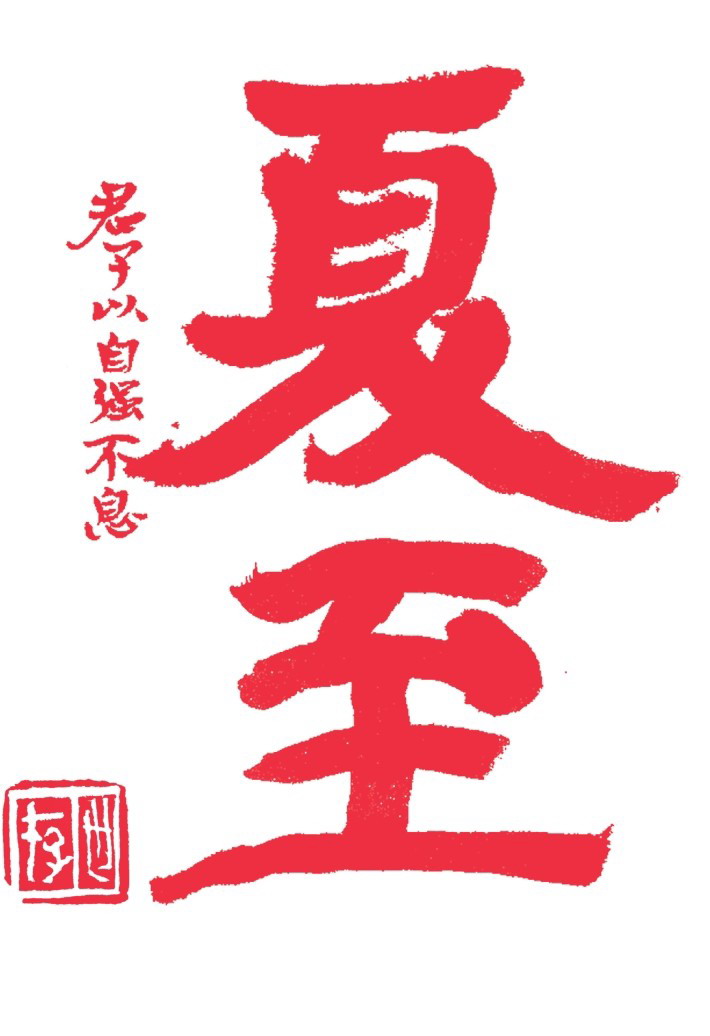
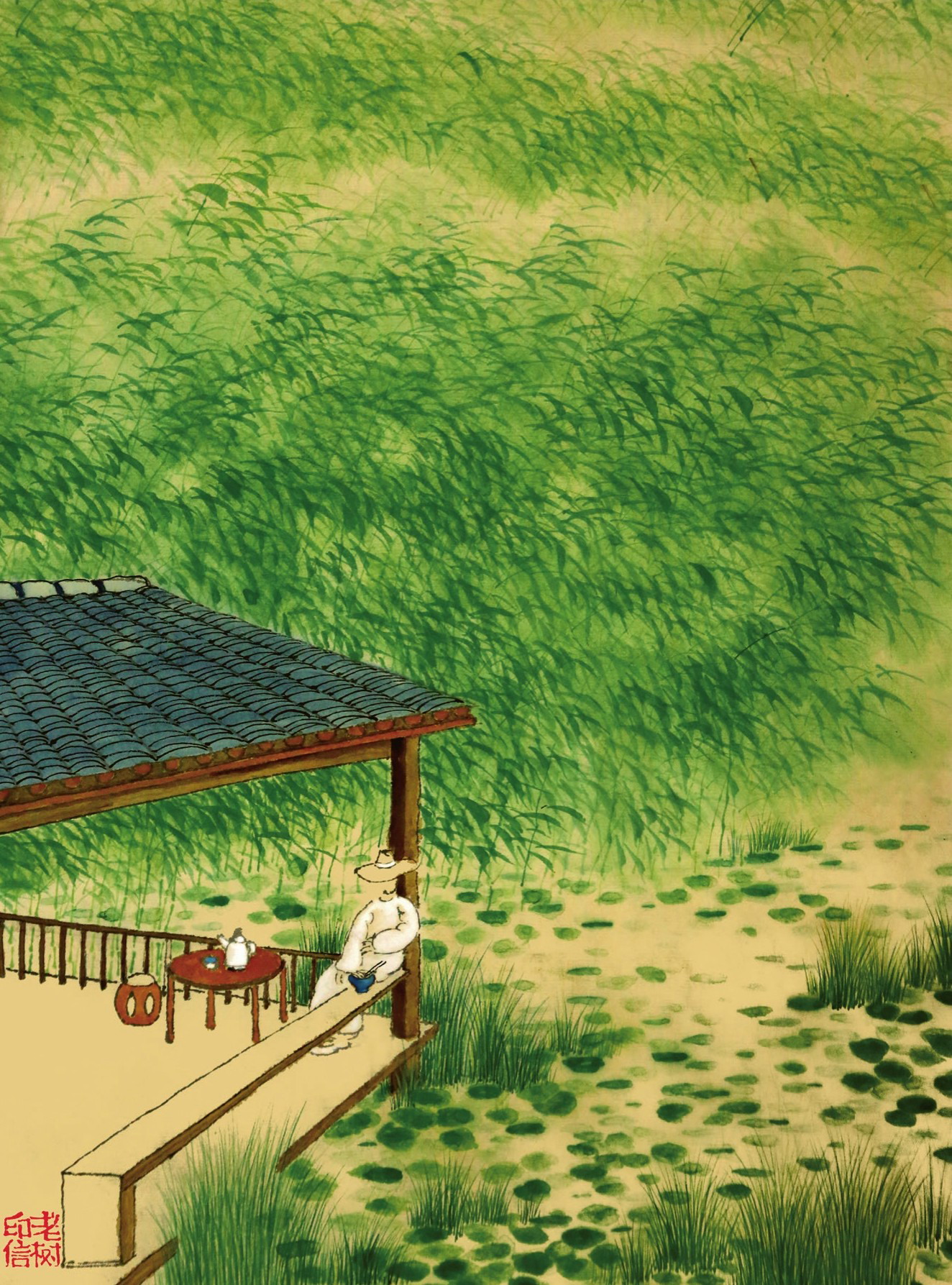
夏至xià zhìSummer Solstice · the peak, where yin is bornahead · the height of light
calligraphy · 夏至painting by 老树 Laoshu · 夏至
Jun 21–22 · longitude 90° · hexagram 乾 The Creative / Heaven
three pentads鹿角解 · 蝉始鸣 · 半夏生
the deer sheds its antlers · the cicada begins to sing · the 半夏 herb sprouts
「日北至,日长之至,日影短至,故曰夏至。至者,极也。」
"The sun reaches its north; the day is at its longest, the shadow at its shortest — so it is called 夏至, the Summer Arrival. 至 means: the utmost."
The sun stands almost straight over the Tropic of Cancer, and the northern day swells to its yearly peak. On this day Mohe, in the far north, has seventeen hours of light;
the southernmost shoal barely twelve and more — a gap of nearly four hours forty minutes. On the Tropic itself a pole casts no shadow; the village of Beiji becomes a
「不夜城」, a town with no night. This is among the first moments of time the world ever fixed — by gnomon-shadow, by Stonehenge, by the Taosi observatory; the watching of this one day
was long ago the great business of a people's life.
But the peak is the turning point itself. After today the sun walks the "road back," its straight ray sliding south, the day shortening by degrees —
「今日一阴生」, today one yin is born. Quan Deyu: "the celestial pivot never stops turning… today one yin is born."
Hence "dumplings at winter solstice, noodles at summer solstice," and a tender little saying: 「吃过夏至面,一天短一线」,
once you've eaten the solstice noodles, each day is a thread shorter.The deepest meaning of 夏至 hides in "reaching the utmost and reversing": at the very fullest moment, the waning has already quietly begun.
The three pentads are all signs of yin rising and yang declining — the yang deer sheds its antlers, the male cicada sings at the new yin, the shade-loving 半夏 herb pushes up in the paddies.
Deer, cicada, 半夏 — each tows a long train of Chinese feeling. The deer 鹿 is love (its hide a wedding gift — "in the wild a dead doe, wrapped in white reeds"),
is virtuous music ("yo-yo cry the deer, grazing the fields' duckweed; I have honoured guests, strike the zither, blow the pipes"), and is power — "Qin lost its deer, and all the world chased it";
Shi Le's "who knows in whose hand the deer will die." The whole language is dappled with deer: 逐鹿中原 (chasing the deer in the heartland), 指鹿为马 (calling a deer a horse), 福禄寿.
The cicada 蝉, shedding its shell to live again, became the emblem of resurrection and undying life; Zhou and Han burials placed a jade cicada in the mouth of the dead;
Luo Binwang heard it from prison: "the autumn cicada sings… none believe in its high purity — who will speak for my heart?" The 半夏 was a mere weed until the Chinese found its medicine in it.
Its hexagram is 乾, the Creative, pure Heaven. Qian's lines are the most familiar string of life-instructions in China: the hidden dragon waits; the dragon appears in the field;
diligent by day, wary by night; leaping at the abyss; the flying dragon in heaven. 「天行健,君子以自强不息」 — heaven moves with strength; the noble one never ceases to strengthen himself.
Energy is at its fullest; lean on nothing external, only press fiercely onward and give out your own light and heat.
Tellingly, on this most-yang of days Yu reaches for something very modern: California's "lights-out" movement after the 2000 blackouts, and China's "Summer-Solstice lights-out" of 2007 —
on the day of greatest yang and heaviest electrical load, to switch the appliances off and give the summer night back to the stars, the evening wind, the scent of jasmine.
Li Qingzhao's defiance fits the hexagram best: 「生当作人杰,死亦为鬼雄。至今思项羽,不肯过江东」 —
in life be a hero among men, in death a champion among ghosts; still I think of Xiang Yu, who would not cross back over the river. As Goethe said: whoever strives unceasingly, him we can redeem.
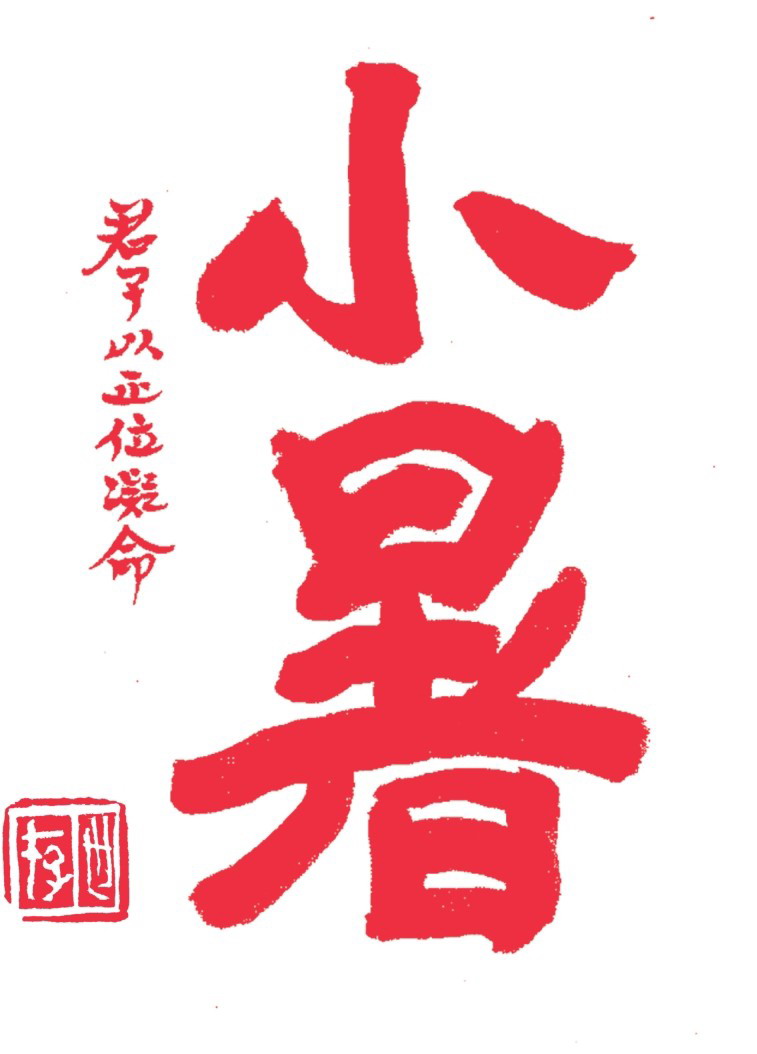
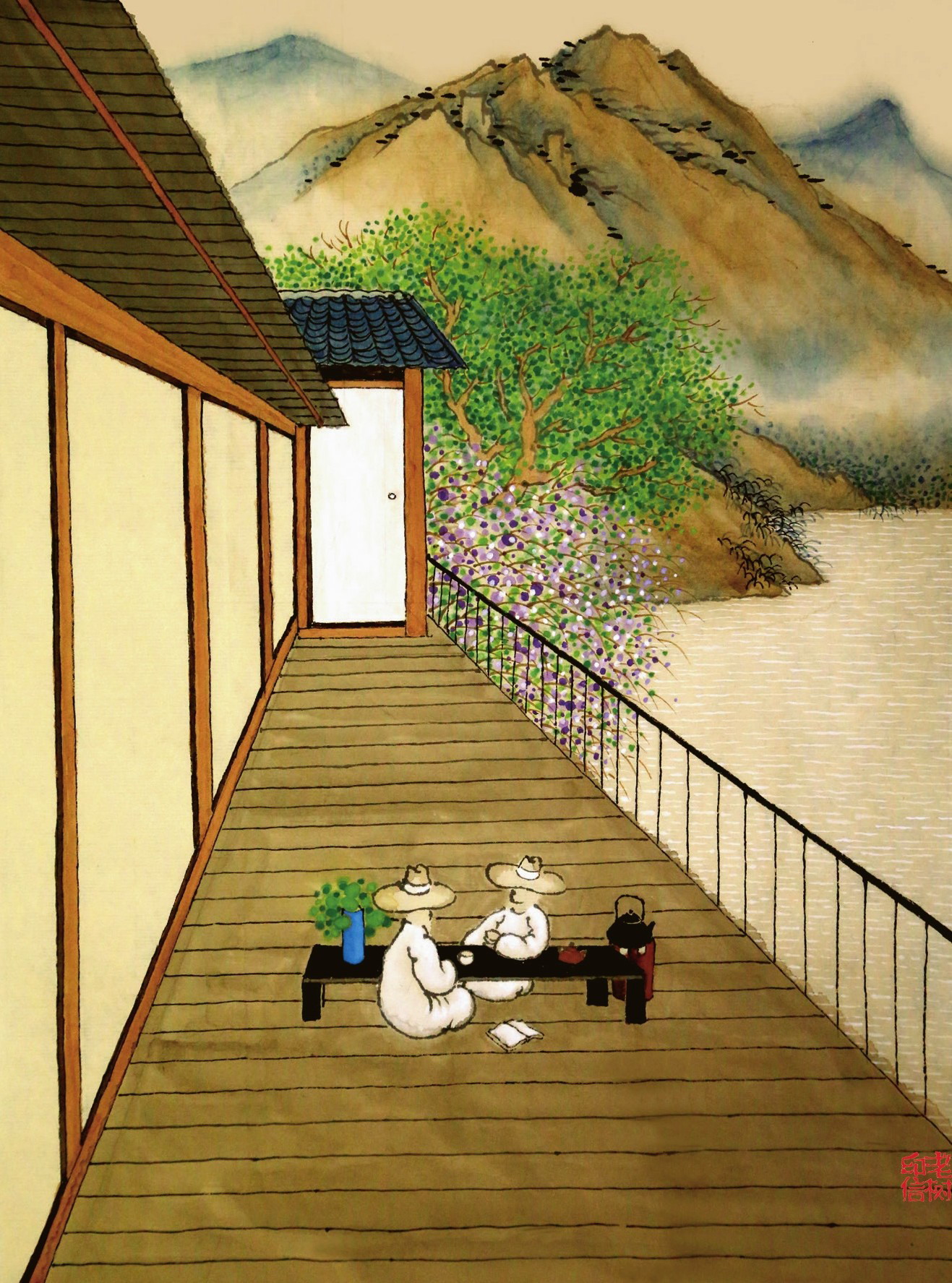
小暑xiǎo shǔMinor Heat · the furnace litahead · heat begins
calligraphy · 小暑painting by 老树 Laoshu · 小暑
Jul 6–8 · longitude 105° · hexagram 鼎 The Cauldron
three pentads温风至 · 蟋蟀居宇 · 鹰始鸷
the warm wind comes · the cricket shelters under the eaves · the young hawk learns to kill
「暑」从日者声 —
the character 暑 (heat) is built on 日, the sun: now everything on earth, people included, is a "sun-borne thing," lit and pressed by the sun.
The proverb says 「小暑大暑,上蒸下煮」, Minor and Major Heat — steamed from above, boiled from below, as if 小暑 were only the overture.
Yet the climate record says the opposite: in most Chinese provinces the extreme high falls in 小暑, and July is the hottest month of the year. Only — "the heat lives in the three 伏" —
the true dog-days wait for the "middle 伏" of 大暑. Now the wind has lost its cool, the cricket 蟋蟀 retreats from the field to the wall's foot under the eaves —
the Book of Songs already charted its route: "in the seventh month afield, the eighth under the eaves, the ninth at the door, the tenth beneath my bed" — and even the hawk must fly to the cool of the high air.
The hawk 鹰 of the third pentad is a sacred, sky-borne bird, the emblem of strength and high purity. From the oracle-bone 鸢 to the bronze-script 鹏 to the seal-script 鹰
is a feat of pictographic art; Zhuangzi swells it to the limit — "the Peng's back, no one knows how many thousand li; it rises in fury, its wings like clouds hung from the sky" — and Li Bai adds,
"the great Peng one day rises with the wind, soaring straight up ninety thousand li." Yet even Peng and hawk must retreat to the high cool in the heat-waves of 小暑 —
the summer's 暑 makes even the strongest flier yield. The cricket, though a pest, became a token of good luck for its song and its fighting, and was named 促织, "the urger-of-weaving,"
nagging the idle wife to weave winter cloth; "the bright moon gleams in the night, the cricket sings at the eastern wall."
Its hexagram is 火风鼎, Fire-over-Wind, the Cauldron: fire above, wind below feeding the flame — the whole figure is a cauldron on the boil,
the very lines suggesting lid, body, legs, and kindling. Nanjing, Wuhan, Chongqing — the "three great furnaces" — are steamed, baked, and roasted inside this cauldron.
But the Cauldron is not only a pot of suffering: 「革物者莫若鼎」, nothing transforms things like the cauldron — it stands for renewal, for power, for creation: 革故鼎新, 问鼎中原, 一言九鼎.
Yu notes a sequence-coincidence: before the Cauldron comes 大过 (Great Excess), "standing alone without fear"; after it comes 恒 (Duration), of thunder and wind.
So 小暑 asks three things together — the spirit to stand alone, the constancy to endure, and above all the will to cooperate with full weight.
The International Day of Cooperatives (first Saturday of July) falls right inside this time-space. Hence the line: 「君子以正位凝命」, the noble one rights his place and gravely holds his charge.
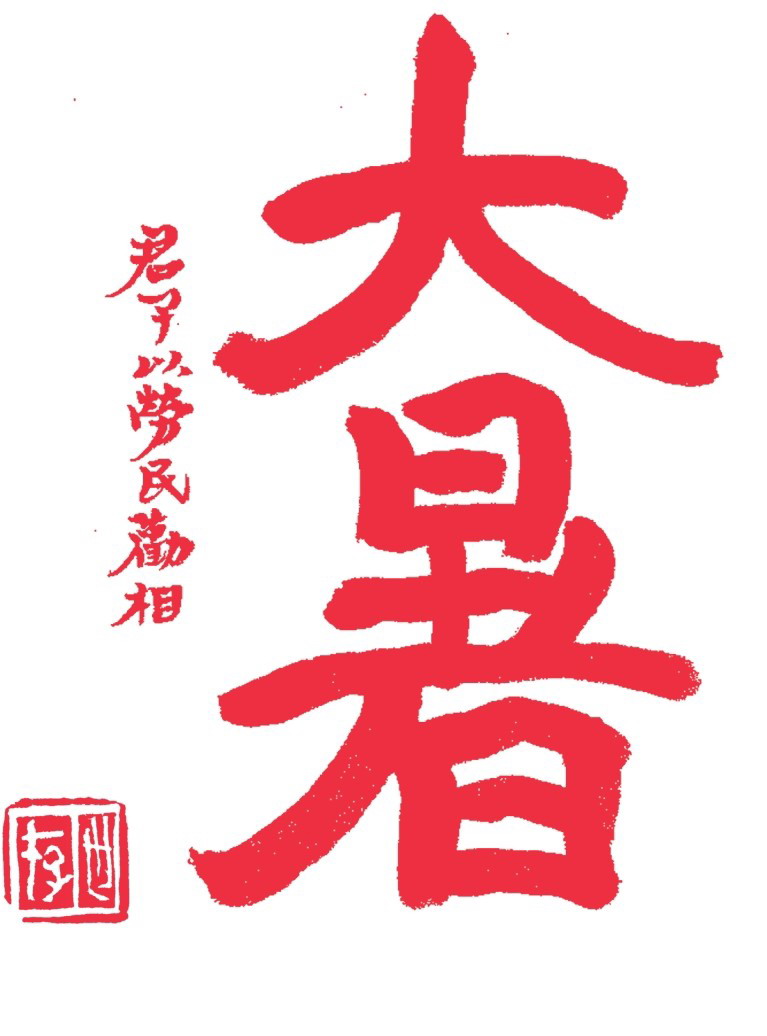
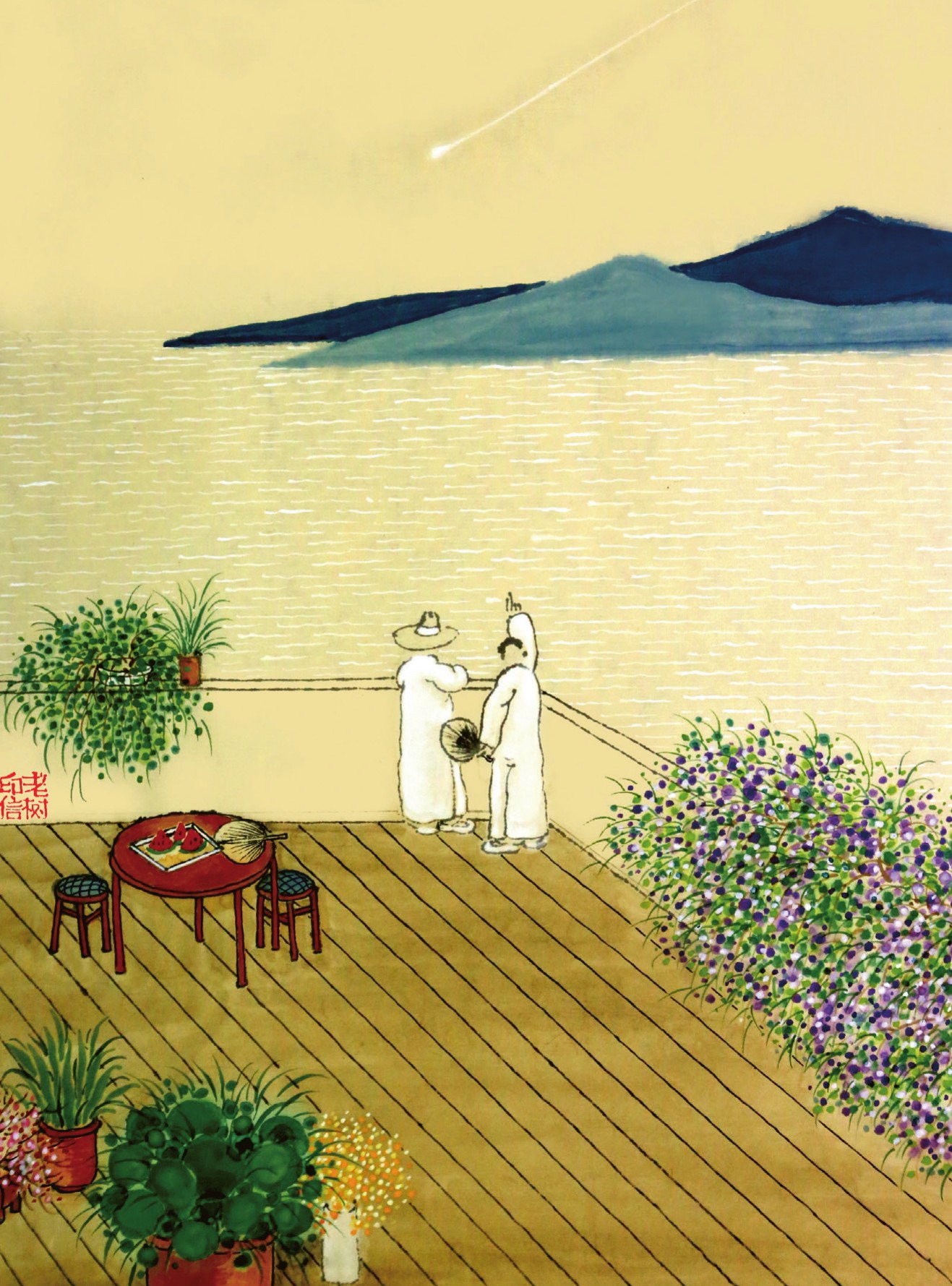
大暑dà shǔMajor Heat · the end of summerahead · heat at its utmost
calligraphy · 大暑painting by 老树 Laoshu · 大暑
Jul 22–24 · longitude 120° · hexagram 井 The Well
three pentads腐草为萤 · 土润溽暑 · 大雨时行
rotting grass turns to fireflies · the earth is damp and the heat sodden · great rains come in their season
The hottest peak of the year — heat enough to become a wonder.
大暑 — Major Heat.
The Classic of Mountains and Seas writes its cruelty as near-myth: 「寿麻正立无景,疾呼无响……爰有大暑,不可以往」 —
Shouma stands straight and casts no shadow, cries out and makes no sound… here is the great heat; one cannot go there. Guo Pu's gloss is blunt: "the heat roasts men to death."
Fan Zhi once wrote on a plain fan, "the great heat drives off the cruel clerk, the clear wind brings an old friend" — which sits beside "tyranny is fiercer than a tiger":
cruel governors are fiercer than tigers, yet not fiercer than 大暑. The first pentad, "rotting grass turns to fireflies," tows in 囊萤映雪 and Che Yin's bag of fireflies,
and also our own dread: fireflies are exquisitely sensitive to soil, water, air — once there are pesticides and chemical fertilizers, the summer nights go dark.
Du Mu's image, "with a light silk fan she swats the drifting fireflies," is vanishing in our hands.
Its hexagram is 水风井, Water-over-Wind, the Well: wood beneath water — a well.
Here Yu turns the whole chapter from a single body to the many — the well is one of humanity's earliest public goods, 公共财.
Digging wells was a great matter in antiquity; a timber frame was laid at the bottom to steady the wall and clear the water — that is "wood beneath water." He says it gravely:
if a state expands its towns without expanding its wells, the people resent it, even rise; today the most vital aid from rich regions to poor ones is still the digging of wells —
"drinking the water, don't forget who dug the well." Laozi's question lives here too: 「孰能浊以止,静之徐清?」 —
who can let the muddy settle, and through stillness slowly clear? It is a search for those with a public heart.
So the line of 大暑 is 「君子以劳民劝相」: the noble one bids the people labour and urges them to help one another.
Tending the body matters; but at summer's end Yu would have us lift the bodily feeling of heat into a collective belonging —
a community without goods that all may share, he says, "is a suspect community, a worrying one."
He closes the whole of summer with Wen Yiduo's Major Heat, written in America in 1922 — a homesick poem that boils the punishing heat down into the ache to go home:
今天是大暑节,我要回家了!
他说家乡的大暑节,是斑鸠唤雨的时候。
大暑到了,湖上漂满紫鸡头……
月下乘凉听打稻,卧看星斗坐吹箫;
我也要回家了,我要回家了!Today is Major Heat — I'm going home!
He says that at home, on the day of Major Heat, it's the hour the turtledoves call for rain.
Major Heat has come; the lake drifts full of purple water-chestnut flowers…
In the moonlight, cooling off, I'd hear the rice being threshed; lie watching the stars, sit and play the flute;
I too am going home — I'm going home!
After summer. That last pentad of 大暑 — "great rains come in their season" — loosens the sodden heat, and the weather begins to slope toward
立秋 Beginning of Autumn: "earth thick, water deep." The season's keyword turns over once more: from summer's 長
(growing, swelling, frenzy, scorching) toward autumn's 收 (gathering in, clearing, "the noble one begins his work with care"). But that is another road.
For now, we're held in —